Synthetic Covariance Explainer
Unknown Unknowns
This year, Satcat Operations processed over 20,000 on-demand ephemeris screenings against the Special Perturbations ephemeris catalog. Published by USSF’s 18th Space Defense Squadron (SDS) via space-track.org, the SP catalog is an invaluable source of predictive ephemeris data for the space object catalog based on USSF’s global Space Surveillance Network (SSN).
However, the SP catalog is missing some key information; while it delivers the same high-accuracy propagated trajectory data that 19th SDS uses to generate millions of close approach notifications every day, it is published without the covariance data that characterizes the uncertainty around those trajectories. Without covariance data, operators screening against the SP catalog are unable to make decisions using probabilistic risk estimation methods such as probability of collision, and are forced to use alternative metrics such as miss distance to determine whether a collision avoidance maneuver is warranted.
Introducing Synthetic Covariance
Today, we’re excited to announce the release of Synthetic Covariance for the SP catalog on Satcat Operations Pro. This feature allows Satcat to compute meaningful Probability of Collision (Pc) metrics on almost every conjunction detected by Satcat Screener, giving operators even more confidence in the safety of their payload.
How It Works
Traditionally, covariance originates during the orbit determination (OD) process, which estimates the uncertainty around the state of the spacecraft by taking into account uncertainties in the underlying tracking measurements and dynamics. This epoch covariance is then propagated along with the predicted trajectory to produce a predictive covariance time series, characterizing the growth of uncertainty as the spacecraft’s flight path is propagated further into the future. Sophisticated flight dynamics systems also measure and correct for covariance realism, that is, the extent to which a covariance statistically describes the actual uncertainty in the spacecraft’s trajectory. This realism is achieved by comparing past predictive and definitive ephemerides and introducing process noise to correct for forces which can’t be perfectly modeled computationally during propagation.
Without an epoch covariance or definitive ephemerides, creating realistic uncertainty information around predicted trajectories is difficult but not impossible. Satcat’s Synthetic Covariance system is based on a statistical analysis of overlaps between previous predictions for each individual object in the catalog. This allows Satcat to develop an uncertainty estimate that responds to the dynamic situation of each object over time, including behavior patterns and changes in physical characteristics. Because it’s based on historical analysis over several weeks of predictions, Synthetic Covariance isn’t available for all objects.
Paradigm Shift
When using the original SP catalog for screenings, operators typically used two surrogate risk metrics in place of true collision probability analysis: miss distance and scaled maximum Pc. Miss distance is a valuable risk metric, but because it doesn’t account for any uncertainty information, it only compares the means of the two uncertainty distributions, ignoring the size of their overlaps. On the other hand, scaled maximum Pc is a method to determine the highest possible value of the collision probability metric given only one of the two objects’ covariances; if that maximum Pc value is still below your operational collision avoidance threshold, then the conjunction can typically be deemed safe.
These two methods can still provide substantial operational value when evaluating the safety of a planned trajectory, particularly when paired with Satcat’s on-demand screening response time. However, their key shortcoming is that they often force operators to be overly conservative by overestimating the actual risk of collision. In today’s crowded spaceflight environment, operators constantly inundated with seemingly urgent risk conjunctions often spend precious time mitigating the risk of collision that they could have spent focusing on achieving their mission objectives.
By enabling computation of true two-sided collision probabilities, Synthetic Covariance allows operators to spend less time worrying about making their mission safe and more time making their mission work. Each collision probability computed using Synthetic Covariance goes through Satcat’s multi-step Pc remediation system, automatically selecting the most accurate method for the conjunction’s geometry.
What’s Next?
Synthetic Covariance is available to Satcat Operations Pro users today. Synthetic Covariance is disabled by default, allowing existing users to continue screening with their established conops and opt into Synthetic Covariance whenever they’re ready in Satcat’s Control Center.
Read more about Synthetic Covariance in Satcat’s documentation.
Staff Software Engineer
Latest blog posts
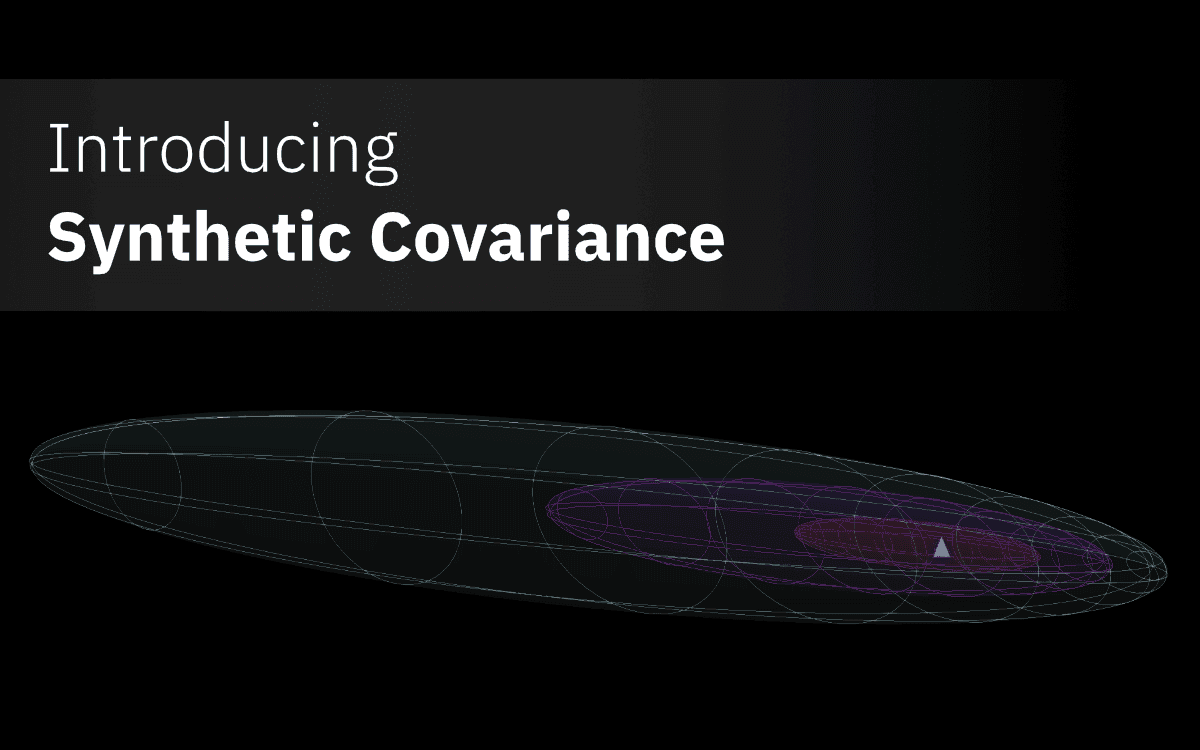
Introducing Synthetic Covariance: Uncertainty and Actionability for the SP Catalog
Satcat Operations Pro now generates Synthetic Covariance for the SP catalog, enabling true Pc on almost every conjunction instead of relying on miss distance alone.
Introducing: Satcat for ChatGPT
Ask ChatGPT about any satellite. Satcat for ChatGPT lets you search the catalog, chart orbits and see satellites on a 3D globe, all in plain language.

Tracking the Tracker: Is Russia's LUCH (OLYMP) Approaching the End of Its Mission?
Launched in 2014, Russia’s Luch (OLYMP) became one of the most closely watched satellites in geostationary orbit for its deliberate proximity operations with commercial and mili...